Schengen Visa from China
An embassy-ready application file — cover letter, day-by-day itinerary, applicant profile, and personalised checklist — formatted for the standards Chinese applicants are graded on.
How Chinese applicants apply for a Schengen visa
Applications are submitted through VFS Global / consulate visa centres (China).
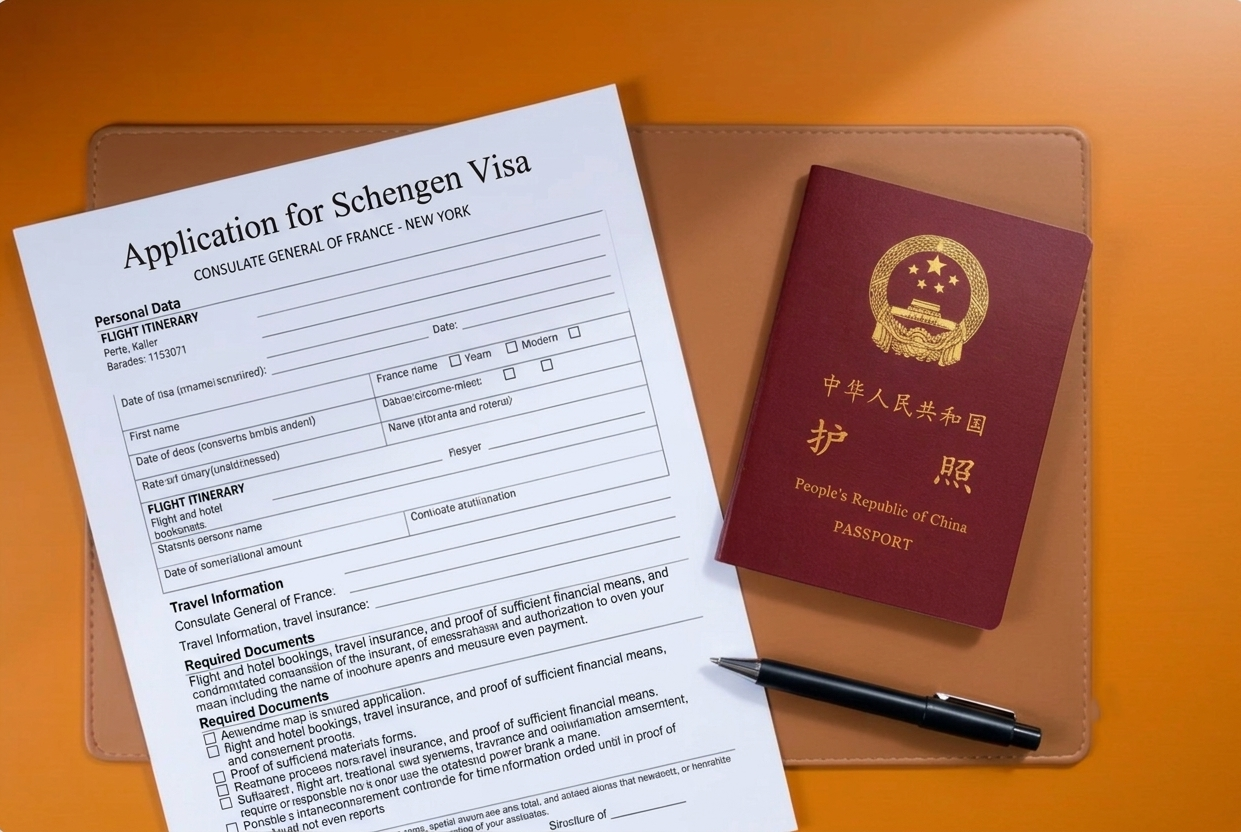
Final documents are written in formal English regardless of the language you fill the form in — the register Schengen consulates expect to read.
This guide covers short-stay Schengen visas (Type C, up to 90 days). For longer stays you need a national long-stay (Type D) visa issued by your destination country.
What's inside your visa file
- Formal cover letter
Structured paragraph by paragraph in the register consulates expect, naming the destination mission and trip purpose.
- Day-by-day itinerary
Dated plan with hotels, intercity transit, and overnight counts that match the consulate of application.
- Applicant profile
Employment, ties, and prior travel summarised in the format reviewers scan for first.
- Personalised checklist
Every supporting document the file needs, including the country-specific ones flagged for your situation.
Top Schengen destinations from China
Schengen refusal rates for applicants in China (2025)
In 2025, Schengen consulates in China took 1,904,861 short-stay decisions and refused 4.0% — below the worldwide rate of 14.6%.
| # | Schengen state | Refusal rate | Decisions | Consulates |
|---|---|---|---|---|
| 1 | Luxembourg | 1.3% | 1,946 | Beijing, Shanghai |
| 2 | Croatia | 1.9% | 9,957 | Beijing |
| 3 | Norway | 2.3% | 52,819 | Beijing, Shanghai |
| 4 | Iceland | 2.3% | 32,805 | Beijing |
| 5 | Belgium | 2.4% | 22,012 | Beijing, Shanghai, Guangzhou (canton) |
| 6 | Austria | 2.5% | 47,371 | Beijing, Shanghai |
| 7 | Czechia | 2.8% | 17,872 | Beijing, Shanghai |
| 8 | Italy | 3.1% | 277,999 | Beijing, Shanghai, Guangzhou (canton), Chongqing |
| 9 | Spain | 3.2% | 304,981 | Beijing, Shanghai, Guangzhou (canton), Chengdu |
| 10 | Finland | 3.2% | 20,624 | Beijing, Shanghai |
| 11 | Hungary | 3.4% | 61,619 | Beijing, Shanghai, Chongqing |
| 12 | Slovakia | 3.5% | 2,248 | Shanghai, Beijing |
| 13 | Germany | 3.7% | 280,498 | Beijing, Shanghai, Guangzhou (canton), Chengdu, Shenyang |
| 14 | Netherlands | 3.8% | 70,211 | Shanghai, Beijing, Guangzhou (canton) |
| 15 | Latvia | 4.1% | 699 | Beijing |
| 16 | Switzerland | 4.4% | 84,829 | Shanghai, Beijing, Guangzhou (canton) |
| 17 | Sweden | 4.7% | 50,299 | Beijing, Shanghai |
| 18 | Greece | 4.7% | 37,481 | Shanghai, Beijing, Guangzhou (canton) |
| 19 | France | 5.2% | 453,011 | Shanghai, Beijing, Guangzhou (canton), Chengdu, Wuhan, Shenyang |
| 20 | Portugal | 7.2% | 22,225 | Shanghai, Guangzhou (canton), Beijing |
| 21 | Denmark | 7.7% | 25,261 | Guangzhou (canton), Beijing, Shanghai |
| 22 | Poland | 9.2% | 15,836 | Shanghai, Beijing, Guangzhou (canton) |
| 23 | Bulgaria | 9.7% | 3,616 | Shanghai, Beijing |
| 24 | Romania | 10.7% | 2,343 | Beijing, Shanghai |
| 25 | Estonia | 13.8% | 716 | Beijing |
| 26 | Slovenia | 15.5% | 2,531 | Beijing |
| 27 | Malta | 19.3% | 3,052 | Beijing, Shanghai |
The gap between the lowest and highest refusal rate in China is 18 percentage points — Luxembourg refused 1.3% of the decisions it took, Malta refused 19.3%.
Source: European Commission — Schengen visa statistics for consulates, 2025. Refusal rate = not issued ÷ decisions taken (uniform visas issued + LTVs issued + not issued). Short-stay (uniform) Schengen visas only. Excludes national long-stay visas. Figures are keyed by country of application — where the consulate sits — not applicant nationality. Applying to the consulate with the best odds is only allowed when it is the state of your main destination — jurisdiction rules come first.
What Chinese applicants need to get right
Chinese applicants submit Schengen visa files through VFS Global, TLScontact, and consulate-operated visa centres in Beijing, Shanghai, Guangzhou, and a handful of regional cities (Chengdu, Shenyang, Hangzhou, Jinan, Wuhan, Xi'an, Kunming). Volume is the highest in the world by single-country count, and France, Italy, Germany, and Spain together absorb the majority of it — France leading on tourism and luxury travel, Italy on tour groups and family, Germany on business and trade-fair attendance.
The Chinese consular ecosystem is unusually centralised: appointment slots release in weekly windows on the visa centre's own portal, walk-ins are not accepted, and the document file you submit at the counter is effectively fixed once handed over. Hukou and household registration sit at the centre of how officers evaluate ties to China — a temporary urban residence permit (居住证) plus the original hukou (户口本) is the standard combination for applicants living outside their registered city.
SchengenDoc generates the formal English cover letter, day-by-day itinerary, applicant profile, and personalised checklist — adapted for Chinese documentation conventions (户口本, 在职证明, 准假证明, 银行流水, 个税截图, 税单) and for the per-consulate differences applicants navigate when choosing between France, Italy, Germany, and Spain.
Frequently asked questions
For a full personalised document list, use our free checklist builder.
- Should I apply through VFS Global or directly at the consulate?
- All major Schengen consulates in China route applications through external visa centres — VFS Global (France, UK, several others), TLScontact (Switzerland, Belgium), Italy Visa Application Centre. The consulates themselves do not accept walk-in applications in Beijing, Shanghai, or Guangzhou. Book the appointment on the visa centre's own portal, not the consulate's site, and submit physically at the centre.
- Which documents need to be translated into French, German, or Italian, and which are accepted in English?
- Standard practice: cover letter and itinerary in English are accepted at virtually all consulates. Civil documents (婚姻证, 出生公证) often require sworn translation into the destination language (French for France, German for Germany, Italian for Italy) — many consulates require these to be notarised in China and then translated by a recognised translator. Bank statements and employment letters in English with company chops (盖章) are usually accepted as-is.
- How do French, Italian, and German consulates differ for Chinese applicants?
- France (VFS) is highest volume and reasonably consistent — processing in 10–15 working days when slots are available, with strong tolerance for repeat applicants. Italy (Italy Visa Centre) is faster for tour-group applications but stricter on individual leisure files. Germany (VFS) is documentation-heavy — expect a longer document list and 15–25 working days. Spain (BLS) handles non-lucrative residence and digital nomad applications alongside short-stay visas.
- Hukou and household registration — when do I need to present them?
- Always. The original hukou (户口本) — including all pages of your household — is part of the standard file. If you are working in a city other than your registered hukou city, attach the temporary residence permit (居住证) for that city. The cover letter should name your hukou city and your current residence city so officers don't have to infer it.
- Bank statements — Chinese domestic bank versus international account, what do officers look at?
- Chinese domestic bank statements (银行流水) from ICBC, CCB, BoC, ABC, or CMB are the primary financial evidence. Officers look for consistent salary credits matching the employer letter, stable balances over three to six months, and the absence of unexplained large credits in the last 30 days. International HSBC or Citi statements supplement but rarely replace domestic statements. Annotate the statements with English headers where the original is Chinese-only.
- Employment letter (在职证明) expectations — SOE, private company, or self-employed?
- State-owned enterprise (国企) and government employees: the unit's official letter on letterhead with the red chop, naming your position, salary, length of service, and approved leave dates. Private company: same format on company letterhead with the corporate seal and the company's business licence (营业执照) attached. Self-employed: business licence in your own name, three to six months of business bank statements, and the most recent tax filing (税单).
- I have no prior Schengen travel history — how do I compensate as a first-time applicant?
- First-time Chinese applicants compensate with documentation depth: a stronger cover letter explaining the trip purpose and return intent, more detailed itinerary with hotel reservations covering every night, fuller financial documentation (six months of statements rather than three), and supporting ties (property certificate 房产证, marriage certificate, parental relationship documents). Prior travel to Japan, South Korea, the UK, the US, or Australia is also a positive signal — attach copies of those visa pages.
- What are the most common rejection reasons specifically for Chinese applicants?
- Three patterns dominate. First, insufficient ties — usually because the cover letter doesn't name them explicitly and the hukou-residence permit story isn't clear. Second, financial inconsistency — salary slip says ¥X but bank credits show ¥Y. Third, itinerary mismatch — applying at the French consulate while the booked nights show the trip is mostly in Italy. Each is fixable at the file level before submission.
- Can I pay the VFS fee with WeChat Pay or Alipay?
- WeChat Pay (微信支付) and Alipay (支付宝) are accepted at VFS Global centres in Beijing and Shanghai for the service fee and visa fee. Smaller regional centres (Chengdu, Shenyang, Wuhan, Xi'an, Kunming) sometimes accept card only — confirm on the VFS portal before your appointment so you arrive with the right payment method.
- Group versus individual applications — what's the difference for Chinese applicants?
- Tour-group applications (through licensed agencies under the ADS — Approved Destination Status programme) are processed in batches with simplified individual files; rejection rates are lower but the trip must be a packaged tour with the agency. Individual applications give you flexibility on itinerary and length but require a fuller personal file. Mixing the two — submitting an individual file but stating you'll travel with a group — is a documented refusal reason; pick one and be consistent.
- Do I need real flight tickets to apply?
- No — a paid, non-refundable ticket is not required. Consulates accept a verifiable flight reservation (a live PNR in the airline's system). Consulates widely flag unverifiable dummy PDFs, and immigration advisors report PNR verification is standard practice at many missions. Submitting an unverifiable reservation can trigger refusal under Article 32(1)(a)(i) of the Visa Code (false or unreliable documents) or Article 32(1)(a)(ii) (purpose and conditions of stay not justified). Best practice is a hold-the-fare reservation or a refundable booking kept live until the decision. The SchengenDoc file produces the day-by-day itinerary document that accompanies — not replaces — your real reservation. See why dummy tickets get rejected.
Helpful guides for Chinese applicants
- Schengen visa cover letter — sample & templateFree covering letter sample plus the one-page format officers expect.
- Day-by-day Schengen visa itinerary templateNights-per-country rule, 7/14/21-day samples, and the format VFS scans first.
- Flight itinerary for visa applicationReservation vs ticket, dummy tickets, and the consulate-by-consulate stance.
- Why Schengen visas get rejectedThe Annex VI refusal codes and the file-level fix for each.
- Schengen visa bank statement — what consulates checkMonths required, stamping rules, and the deposits that trigger refusal.
- Employment letter / NOC for Schengen visaTemplate, salary disclosure, and what self-employed applicants substitute.
Related country guides
Same region or similar consular routing as China.
- Schengen Visa from South KoreaConsulate appointment portals (South Korea)
- Schengen Visa from JapanConsulate appointment portals (Japan)
- Schengen Visa from SingaporeVFS Global Singapore / TLScontact Singapore
- Schengen Visa from ThailandVFS Global Thailand
- Schengen Visa from MalaysiaVFS Global Malaysia / TLScontact Malaysia