Schengen Visa from Nigeria
An embassy-ready application file — cover letter, day-by-day itinerary, applicant profile, and personalised checklist — formatted for the standards Nigerian applicants are graded on.
How Nigerian applicants apply for a Schengen visa
Applications are submitted through VFS Global and TLScontact Nigeria.
Prefer to do it yourself?Read our free sample letters
Check your passport instantly
Rules depend on your passport, not just where you apply from. Select your passport to see whether you need a visa at all.
Where to submit from Nigeria
Apply to the consulate of your main destination. Each channel below was checked on the linked official page on 29 October 2026. Providers can change, so confirm before you book.
- FranceTLScontact — appointment and service fee booked on its website · How to book with TLScontactOfficial source
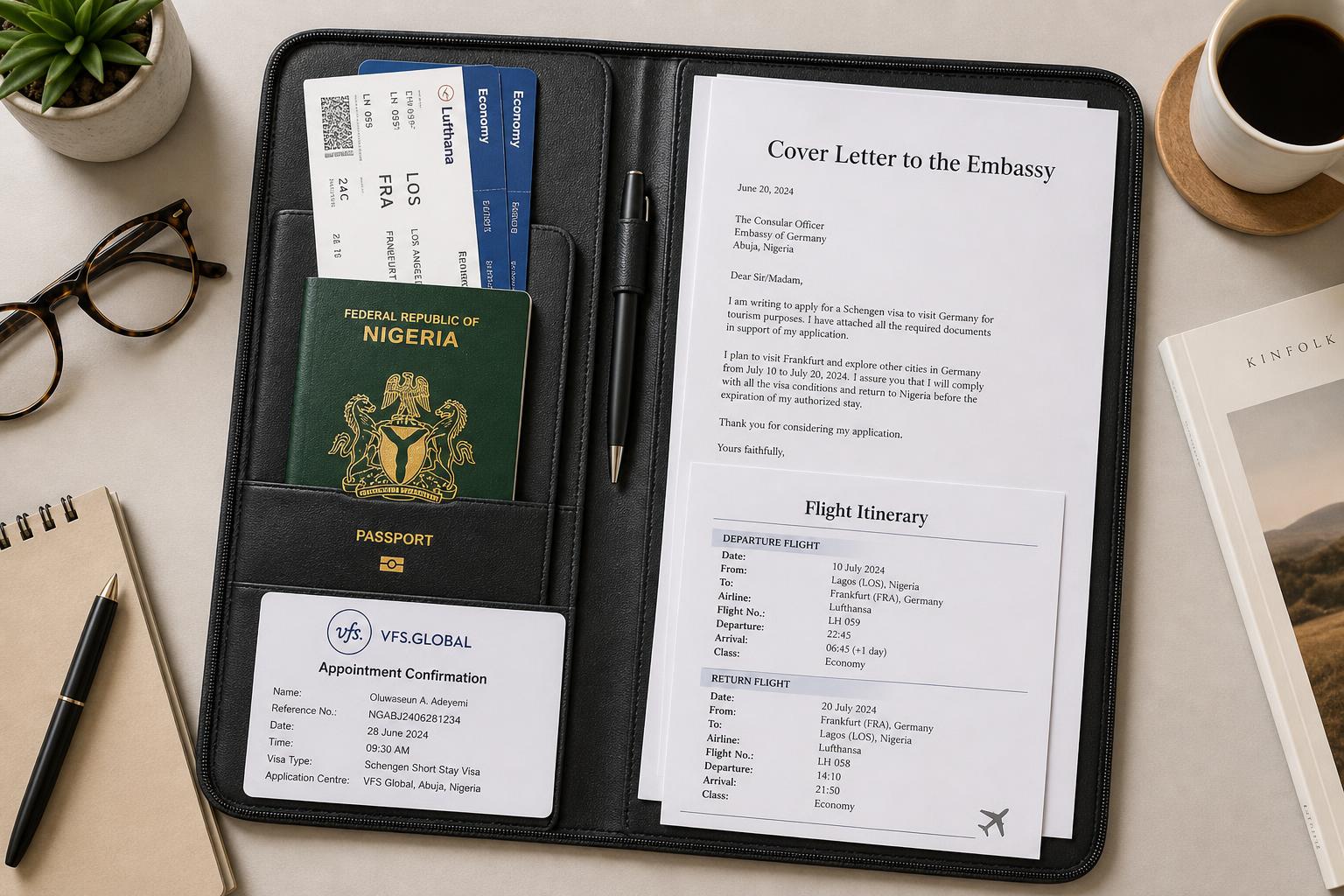
Final documents are written in formal English regardless of the language you fill the form in — the register Schengen consulates expect to read.
This guide covers short-stay Schengen visas (Type C, up to 90 days). For longer stays you need a national long-stay (Type D) visa issued by your destination country.
What's inside your visa file
- Formal cover letter
Structured paragraph by paragraph in the register consulates expect, naming the destination mission and trip purpose.
- Day-by-day itinerary
Dated plan with hotels, intercity transit, and overnight counts that match the consulate of application.
- Applicant profile
Employment, ties, and prior travel summarised in the format reviewers scan for first.
- Personalised checklist
Every supporting document the file needs, including the country-specific ones flagged for your situation.
Top Schengen destinations from Nigeria
Schengen refusal rates for applications made in Nigeria (2025)
In 2025, Schengen consulates in Nigeria took 110,956 short-stay decisions and refused 47.9% — above the worldwide rate of 14.6%.
These figures cover decided applications made in Nigeria, regardless of passport nationality. They are not refusal rates for Nigeria passport holders and do not predict an individual's outcome.
| # | Schengen state | Refusal rate | Decisions | Consulates |
|---|---|---|---|---|
| 1 | Switzerland | 27.2% | 2,597 | Abuja |
| 2 | Germany | 29.2% | 7,672 | Lagos, Abuja |
| 3 | Austria | 39.1% | 1,587 | Abuja |
| 4 | Czechia | 41.0% | 610 | Abuja |
| 5 | Italy | 42.2% | 13,649 | Lagos, Abuja |
| 6 | Poland | 46.1% | 671 | Abuja |
| 7 | France | 48.5% | 57,280 | Lagos, Abuja |
| 8 | Hungary | 52.8% | 623 | Abuja |
| 9 | Finland | 55.0% | 1,635 | Abuja |
| 10 | Spain | 55.8% | 8,971 | Lagos, Abuja |
| 11 | Portugal | 56.3% | 3,043 | Abuja |
| 12 | Denmark | 59.2% | 2,370 | Abuja |
| 13 | Belgium | 60.9% | 7,389 | Abuja |
| 14 | Bulgaria | 66.1% | 2,102 | Abuja |
The gap between the lowest and highest refusal rate in Nigeria is 38.9 percentage points — Switzerland refused 27.2% of the decisions it took, Bulgaria refused 66.1%.
Source: European Commission — Schengen visa statistics for consulates, 2025. Refusal rate = not issued ÷ decisions taken (uniform visas issued + LTVs issued + not issued). Short-stay (uniform) Schengen visas only. Excludes national long-stay visas. Figures are keyed by country of application — where the consulate sits — not applicant nationality. Applying to the consulate with the best odds is only allowed when it is the state of your main destination — jurisdiction rules come first.
What Nigerian applicants need to get right
Nigerian passport holders submit Schengen short-stay applications through VFS Global and TLScontact centres in Abuja and Lagos, with a smaller footprint in Port Harcourt for some missions. French applications route through TLScontact; other destinations use the centre named on their consulate's website. Appointment slots release in narrow weekly windows and the document file you bring on the day is essentially fixed once submitted, so the cover letter, itinerary, and supporting evidence have to be internally consistent from the start.
Refusal patterns out of Nigeria cluster around two themes: insufficient demonstration of socio-economic ties (the consulate is not convinced you will return), and gaps between the stated itinerary and the financial story. Salaried applicants are expected to attach a letter of employment on company letterhead confirming role, salary, joining date, approved leave, and return-to-work, plus three to six months of payslips and FIRS / tax clearance certificates. Self-employed applicants substitute the employment letter with CAC registration documents and FIRS tax records for the business.
Financial proof is read as a coherent story across the last six months of bank statements. Consulates compare daily budget on the itinerary against closing balances in Naira and any domiciliary (USD/EUR/GBP) accounts, and against salary credits. A SchengenDoc file produces the cover letter, day-by-day itinerary, and personalised checklist in the formal English register Schengen missions expect — so every document references the same dates, the same hotels, and the same financial cover.
Frequently asked questions
For a full personalised document list, use our free checklist builder.
- Where do I apply for a Schengen visa in Nigeria?
- It depends on the destination. France routes through TLScontact in Abuja and Lagos. For Germany and other destinations, book through the link on the consulate's own website, because providers differ by mission. Always apply to the consulate of your main destination by nights spent, even if another centre has earlier appointments.
- Do I need a tax clearance certificate (TCC) for a Schengen visa from Nigeria?
- Yes for salaried applicants — the FIRS or state tax clearance certificate for the previous year is a standard expectation alongside three to six months of payslips. Self-employed applicants attach the CAC registration documents and FIRS tax records for the business. The tax record is the consulate's cross-check on the income stated in your employment or business letter.
- How long does my Nigerian passport need to be valid for a Schengen application?
- Your passport must be valid for at least three months beyond your planned date of return from the Schengen area, with at least two blank pages, and issued within the last ten years. Applying close to the three-month margin raises the risk of refusal regardless of the rest of the file.
- Do I need real flight tickets to apply?
- No — a paid, non-refundable ticket is not required. Consulates accept a verifiable flight reservation (a live PNR in the airline's system). Consular officers can check booking references directly, and unverifiable reservations risk refusal. Submitting an unverifiable reservation can trigger refusal under Article 32(1)(b) of the Visa Code (reasonable doubts about the authenticity of supporting documents or the veracity of their contents) or Article 32(1)(a)(ii) (purpose and conditions of stay not justified). Best practice is a hold-the-fare reservation or a refundable booking kept live until the decision. The SchengenDoc file produces the day-by-day itinerary document that accompanies — not replaces — your real reservation. See why dummy tickets get rejected.
Helpful guides for Nigerian applicants
- Schengen visa cover letter — sample & templateFree covering letter sample plus the one-page format officers expect.
- Day-by-day Schengen visa itinerary templateNights-per-country rule, 7/14/21-day samples, and the format VFS scans first.
- Flight itinerary for visa applicationReservation vs ticket, dummy tickets, and the consulate-by-consulate stance.
- Why Schengen visas get rejectedThe Annex VI refusal codes and the file-level fix for each.
- Schengen visa bank statement — what consulates checkMonths required, stamping rules, and the deposits that trigger refusal.
- Employment letter / NOC for Schengen visaTemplate, salary disclosure, and what self-employed applicants substitute.
Related country guides
Same region or similar consular routing as Nigeria.
- Schengen Visa from GhanaVFS Global / TLScontact Ghana
- Schengen Visa from KenyaVFS Global and TLScontact Kenya
- Schengen Visa from South AfricaVFS Global and Capago South Africa
- Schengen Visa from EthiopiaVFS Global / consulate appointment portals (Addis Ababa)
- Schengen Visa from EgyptVFS Global and TLScontact Egypt