Schengen Visa from South Korea
An embassy-ready application file — cover letter, day-by-day itinerary, applicant profile, and personalised checklist — formatted for the standards South Korean applicants are graded on.
How South Korean applicants apply for a Schengen visa
Applications are submitted through Consulate appointment portals (South Korea).
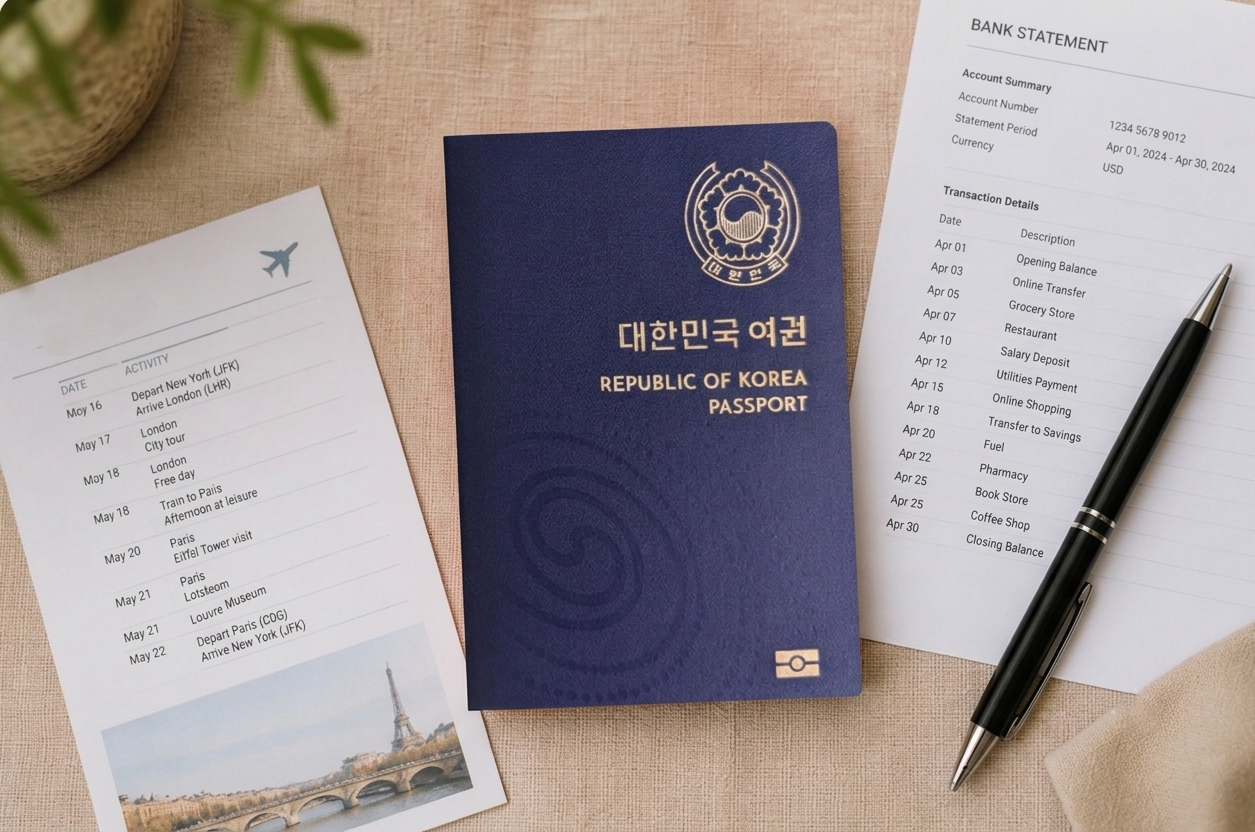
What's inside your visa file
- Formal cover letter
Structured paragraph by paragraph in the register consulates expect, naming the destination mission and trip purpose.
- Day-by-day itinerary
Dated plan with hotels, intercity transit, and overnight counts that match the consulate of application.
- Applicant profile
Employment, ties, and prior travel summarised in the format reviewers scan for first.
- Personalised checklist
Every supporting document the file needs, including the country-specific ones flagged for your situation.
Top Schengen destinations from South Korea
Schengen refusal rates for applicants in South Korea (2025)
In 2025, Schengen consulates in South Korea took 5,061 short-stay decisions and refused 11.5% — below the worldwide rate of 14.6%.
| # | Schengen state | Refusal rate | Decisions | Consulates |
|---|---|---|---|---|
| 1 | Spain | 3.6% | 773 | Seoul |
| 2 | Germany | 9.2% | 697 | Seoul |
| 3 | Italy | 9.7% | 785 | Seoul |
| 4 | France | 12.1% | 659 | Seoul |
The gap between the lowest and highest refusal rate in South Korea is 8.5 percentage points — Spain refused 3.6% of the decisions it took, France refused 12.1%.
Source: European Commission — Schengen visa statistics for consulates, 2025. Refusal rate = not issued ÷ decisions taken (uniform visas issued + LTVs issued + not issued). Short-stay (uniform) Schengen visas only. Excludes national long-stay visas. Figures are keyed by country of application — where the consulate sits — not applicant nationality. Applying to the consulate with the best odds is only allowed when it is the state of your main destination — jurisdiction rules come first.
What South Korean applicants need to get right
South Koreans don't need a visa for stays under 90 days in the Schengen area. Planning to study, work, or stay longer? You'll need a national long-stay visa (D-series) from the consulate of your main destination — and that file is materially heavier than a short tourist trip. The French, Italian, German, and Spanish consulates in Seoul handle the bulk of long-stay applications, with student visas, working-holiday visas, and skilled-work permits dominating the volume.
Long-stay refusals from Korea usually trace back to two issues: financial proof that doesn't cover the entire duration without working in the destination country, and a visa category mismatch — for example, applying for a tourism short-stay visa when the actual plan is a multi-month language course (which requires a student visa). Apostilled civil and academic documents are mandatory for most categories.
SchengenDoc generates the formal English or Korean cover letter, day-by-day itinerary, applicant profile, and personalised checklist long-stay applicants are graded on — written in the register Seoul consulates expect, with the visa category named explicitly.
Frequently asked questions
For a full personalised document list, use our free checklist builder.
- Do South Koreans need a visa for Schengen?
- Not for short stays. South Korean passport holders can enter visa-free for up to 90 days in any 180-day period for tourism, business, or family visits. A national long-stay visa is required for studies, work, working-holiday programmes, or any stay over 90 days — and that's what this file prepares.
- Planning a short trip? Do I need ETIAS?
- ETIAS launches Q4 2026 — South Koreans will need to register online before short trips once it's mandatory. But ETIAS is a pre-travel authorization you apply for yourself online, not a visa. For stays over 90 days you'll still need a national visa, and this file covers those documents.
- Which Korean documents need apostilling for a long-stay visa?
- Civil-status documents (가족관계증명서, 혼인관계증명서, 기본증명서) and the criminal-record check (경찰청 범죄경력회보서) require the Hague Apostille from the Ministry of Foreign Affairs (외교부). Academic transcripts and degree certificates from Korean universities should be apostilled directly; consulates may also accept university-issued sealed envelopes for student-visa applications.
- Working-holiday visa from Korea — what's different from a regular long-stay?
- France, Germany, Italy, Spain, the Netherlands, and several others operate working-holiday agreements with Korea for applicants aged 18–30 (or 18–35 for some destinations). The file is lighter — proof of funds (~€2,500), return ticket or equivalent funds, health insurance for the full stay, and a cover letter naming the working-holiday programme — but slots are quota-limited per year.
- How long does a long-stay visa from Korea take?
- France, Germany, and Italy typically process long-stay applications in 15–25 working days from Seoul; student-visa files going through CAMPUS France or DAAD interviews add another 2–4 weeks upstream. Apply at least 8 weeks before the planned departure.
- Do I need real flight tickets to apply?
- No — a paid, non-refundable ticket is not required. Consulates accept a verifiable flight reservation (a live PNR in the airline's system). Consulates widely flag unverifiable dummy PDFs, and immigration advisors report PNR verification is standard practice at many missions. Submitting an unverifiable reservation can trigger refusal under Article 32(1)(a)(i) of the Visa Code (false or unreliable documents) or Article 32(1)(a)(ii) (purpose and conditions of stay not justified). Best practice is a hold-the-fare reservation or a refundable booking kept live until the decision. The SchengenDoc file produces the day-by-day itinerary document that accompanies — not replaces — your real reservation. See why dummy tickets get rejected.
Helpful guides for South Korean applicants
- Schengen visa cover letter — sample & templateFree covering letter sample plus the one-page format officers expect.
- Day-by-day Schengen visa itinerary templateNights-per-country rule, 7/14/21-day samples, and the format VFS scans first.
- Flight itinerary for visa applicationReservation vs ticket, dummy tickets, and the consulate-by-consulate stance.
- Why Schengen visas get rejectedThe Annex VI refusal codes and the file-level fix for each.
- Schengen visa bank statement — what consulates checkMonths required, stamping rules, and the deposits that trigger refusal.
- Employment letter / NOC for Schengen visaTemplate, salary disclosure, and what self-employed applicants substitute.
Related country guides
Same region or similar consular routing as South Korea.
- Schengen Visa from JapanConsulate appointment portals (Japan)
- Schengen Visa from ChinaVFS Global / consulate visa centres (China)
- Schengen Visa from SingaporeVFS Global Singapore / TLScontact Singapore
- Schengen Visa from ThailandVFS Global Thailand
- Schengen Visa from VietnamVFS Global Vietnam / TLScontact Vietnam