Schengen Visa from the Democratic Republic of the Congo
An embassy-ready application file — cover letter, day-by-day itinerary, applicant profile, and personalised checklist — formatted for the standards Congolese applicants are graded on.
How Congolese applicants apply for a Schengen visa
Applications are submitted through Belgian consulate, Kinshasa (with VFS Global routing for several missions).
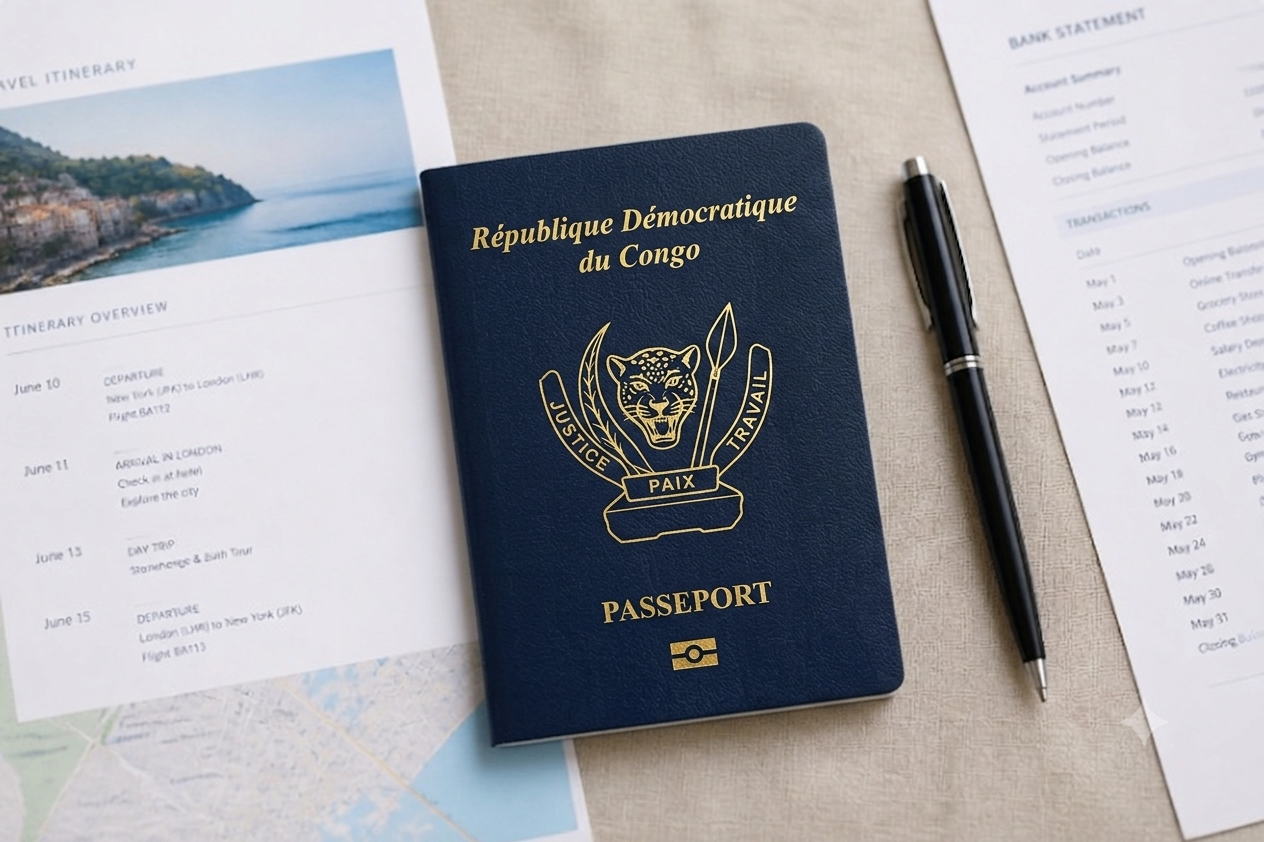
Final documents are written in formal English regardless of the language you fill the form in — the register Schengen consulates expect to read.
This guide covers short-stay Schengen visas (Type C, up to 90 days). For longer stays you need a national long-stay (Type D) visa issued by your destination country.
What's inside your visa file
- Formal cover letter
Structured paragraph by paragraph in the register consulates expect, naming the destination mission and trip purpose.
- Day-by-day itinerary
Dated plan with hotels, intercity transit, and overnight counts that match the consulate of application.
- Applicant profile
Employment, ties, and prior travel summarised in the format reviewers scan for first.
- Personalised checklist
Every supporting document the file needs, including the country-specific ones flagged for your situation.
Top Schengen destinations from the Democratic Republic of the Congo
Schengen refusal rates for applicants in the Democratic Republic of the Congo (2025)
In 2025, Schengen consulates in Congo (Democratic Republic) took 51,133 short-stay decisions and refused 40.1% — above the worldwide rate of 14.6%.
| # | Schengen state | Refusal rate | Decisions | Consulates |
|---|---|---|---|---|
| 1 | Belgium | 34.9% | 39,234 | Kinshasa, Lubumbashi |
| 2 | Greece | 49.5% | 4,737 | Kinshasa |
| 3 | Spain | 62.2% | 4,094 | Kinshasa |
| 4 | Switzerland | 72.9% | 2,630 | Kinshasa |
The gap between the lowest and highest refusal rate in the Democratic Republic of the Congo is 38 percentage points — Belgium refused 34.9% of the decisions it took, Switzerland refused 72.9%.
Source: European Commission — Schengen visa statistics for consulates, 2025. Refusal rate = not issued ÷ decisions taken (uniform visas issued + LTVs issued + not issued). Short-stay (uniform) Schengen visas only. Excludes national long-stay visas. Figures are keyed by country of application — where the consulate sits — not applicant nationality. Applying to the consulate with the best odds is only allowed when it is the state of your main destination — jurisdiction rules come first.
What Congolese applicants need to get right
DRC applicants submit Schengen short-stay visas primarily through the Belgian consulate in Kinshasa — Belgium is the historic and dominant Schengen destination for Congolese travellers, with deep family, professional, and student ties — and through the French consulate for files where France is the main destination. Germany, the Netherlands, and other missions handle smaller volumes via VFS Global routing from Kinshasa.
Documentation is the single largest controllable factor for DRC applicants. Schengen refusal rates for files lodged in the DRC are consistently among the highest in the world — published data has placed them above 50% for several Schengen states in recent years — and the dominant refusal grounds are Annex VI codes 2 (purpose of stay not justified) and 9 (intention to leave not established). Both reduce to paperwork: a cover letter that doesn't tie the trip to a clear return reason, an itinerary that doesn't match the consulate of application, a sponsor file that doesn't reconcile with the applicant's claimed purpose, or financial proof that doesn't match the cover-letter funding story.
SchengenDoc generates the formal cover letter, day-by-day itinerary, and personalised checklist DRC applicants need at the Belgian consulate or VFS Kinshasa. The file is written in formal English (translated automatically from French), names the host consulate, frames sponsorship correctly where it applies (Belgian engagement de prise en charge, French attestation d'accueil), and flags the DRC-specific documents — employer attestation, pay slips, RCCM business registration for self-employed applicants, and bank statements stamped by the issuing branch — that the file has to carry to survive the high-scrutiny review.
Frequently asked questions
For a full personalised document list, use our free checklist builder.
- Do DRC applicants apply through the Belgian or French consulate?
- It depends on the destination. Belgium is the dominant Schengen destination from the DRC and most Congolese applicants file through the Belgian consulate in Kinshasa. If France is your main destination by nights spent, file with the French consulate. Germany, the Netherlands, and other missions accept smaller volumes through VFS Global Kinshasa. Apply to the consulate of your main destination, even if another mission has faster appointments.
- Why do DRC applicants face some of the highest Schengen rejection rates — and how does documentation help?
- Refusal rates for files lodged in the DRC are consistently among the highest worldwide, and the dominant grounds are Annex VI codes 2 (purpose of stay not justified) and 9 (intention to leave not established). Both are paperwork issues the applicant controls. A structured cover letter naming the consulate and trip purpose, an itinerary matched to the consulate of application, a sponsor file that reconciles with your claimed purpose, and a coherent six-month financial story address the file-level causes directly. Documentation won't change a refusal driven by your circumstances — but it's the largest factor you control.
- What sponsorship documents are required for family visit applications?
- For Belgian applications, the host in Belgium provides an engagement de prise en charge (Annex 3bis) — a sworn commitment to cover your stay, processed at the host's commune — together with proof of income, accommodation, and identity. For French applications, the host obtains an attestation d'accueil from their local mairie, with the same supporting documents. A private invitation letter on its own is not accepted by either consulate.
- What financial proof is expected in Congolese francs?
- Three to six months of bank statements — Congolese francs or USD, whichever your account holds — stamped by the issuing branch, showing salary or business credits consistent with the cover letter and closing balances that cover the trip cost (or document the sponsor's contribution where applicable). Foreign-currency accounts held in the DRC or abroad are accepted and often read more cleanly. Avoid large unexplained deposits in the 30 days before applying.
- What are the most common rejection reasons specific to DRC applicants?
- Three patterns dominate. First, sponsor files that don't reconcile — a sponsor in Belgium whose declared income doesn't credibly cover the trip, or whose engagement de prise en charge is missing the commune stamp. Second, weak return-intent evidence — no documented employment, no property, no dependents remaining in the DRC, or recent life events (job loss, divorce) that the file doesn't address. Third, financial documentation that doesn't reconcile with the cover letter — bank statements showing balances the salary doesn't explain, or large pre-application deposits.
- How should applicants with no prior travel history present their case?
- A blank passport is not by itself a refusal reason, but for DRC applicants it shifts more weight onto everything else in the file. Compensate with stronger employment documentation (attestation on letterhead, three pay slips, signed leave approval), property or business ownership documents, a tight return-intent paragraph in the cover letter referencing employment and family ties remaining in the DRC, and an itinerary with confirmed hotels and dated transit. Build the case on ties and document quality, not on stamps you don't have yet.
- Do I need real flight tickets to apply?
- No — a paid, non-refundable ticket is not required. Consulates accept a verifiable flight reservation (a live PNR in the airline's system). Consulates widely flag unverifiable dummy PDFs, and immigration advisors report PNR verification is standard practice at many missions. Submitting an unverifiable reservation can trigger refusal under Article 32(1)(a)(i) of the Visa Code (false or unreliable documents) or Article 32(1)(a)(ii) (purpose and conditions of stay not justified). Best practice is a hold-the-fare reservation or a refundable booking kept live until the decision. The SchengenDoc file produces the day-by-day itinerary document that accompanies — not replaces — your real reservation. See why dummy tickets get rejected.
Helpful guides for Congolese applicants
- Schengen visa cover letter — sample & templateFree covering letter sample plus the one-page format officers expect.
- Day-by-day Schengen visa itinerary templateNights-per-country rule, 7/14/21-day samples, and the format VFS scans first.
- Flight itinerary for visa applicationReservation vs ticket, dummy tickets, and the consulate-by-consulate stance.
- Why Schengen visas get rejectedThe Annex VI refusal codes and the file-level fix for each.
- Schengen visa bank statement — what consulates checkMonths required, stamping rules, and the deposits that trigger refusal.
- Employment letter / NOC for Schengen visaTemplate, salary disclosure, and what self-employed applicants substitute.
Related country guides
Same region or similar consular routing as the Democratic Republic of the Congo.