Schengen Visa from Morocco
An embassy-ready application file — cover letter, day-by-day itinerary, applicant profile, and personalised checklist — formatted for the standards Moroccan applicants are graded on.
How Moroccan applicants apply for a Schengen visa
Applications are submitted through TLScontact / VFS Global Morocco.
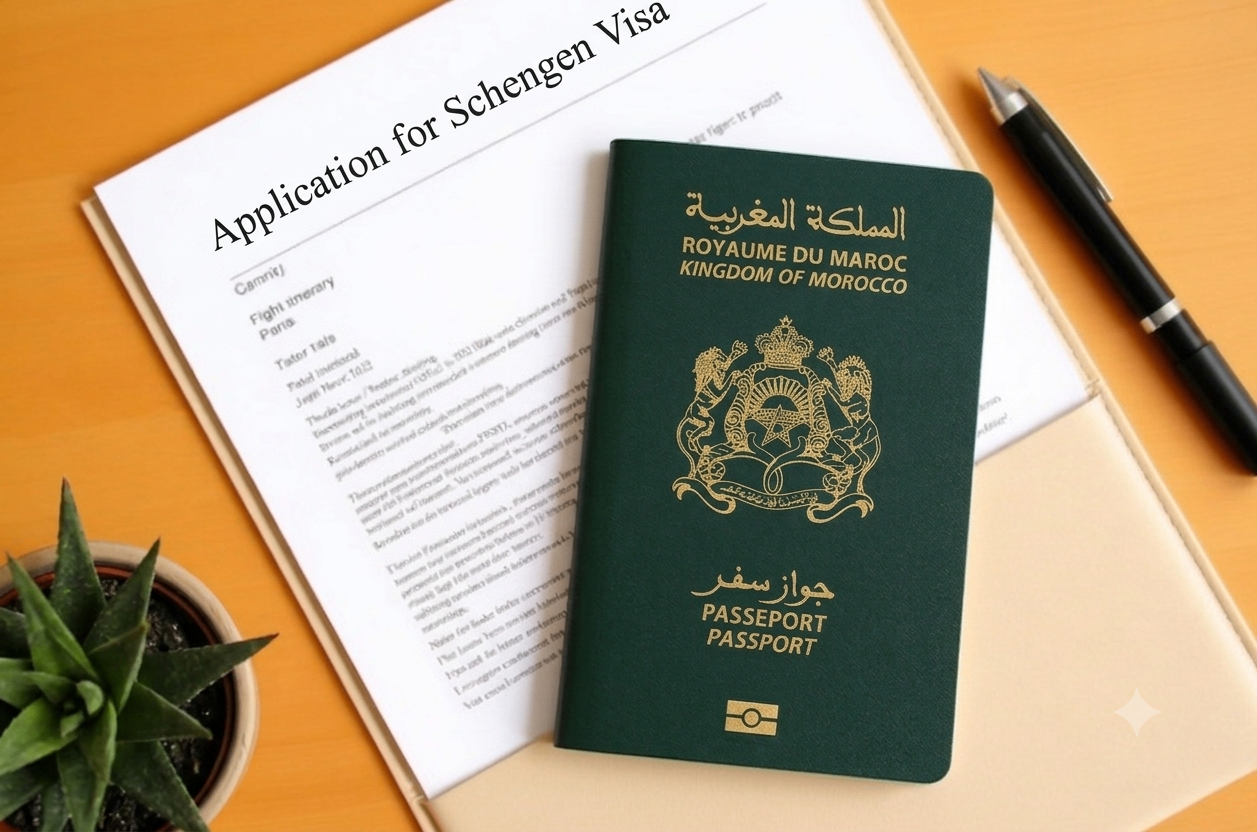
Final documents are written in formal English regardless of the language you fill the form in — the register Schengen consulates expect to read.
This guide covers short-stay Schengen visas (Type C, up to 90 days). For longer stays you need a national long-stay (Type D) visa issued by your destination country.
What's inside your visa file
- Formal cover letter
Structured paragraph by paragraph in the register consulates expect, naming the destination mission and trip purpose.
- Day-by-day itinerary
Dated plan with hotels, intercity transit, and overnight counts that match the consulate of application.
- Applicant profile
Employment, ties, and prior travel summarised in the format reviewers scan for first.
- Personalised checklist
Every supporting document the file needs, including the country-specific ones flagged for your situation.
Top Schengen destinations from Morocco
Schengen refusal rates for applicants in Morocco (2025)
In 2025, Schengen consulates in Morocco took 595,748 short-stay decisions and refused 19.2% — above the worldwide rate of 14.6%.
| # | Schengen state | Refusal rate | Decisions | Consulates |
|---|---|---|---|---|
| 1 | France | 10.0% | 293,019 | Rabat, Casablanca |
| 2 | Bulgaria | 15.1% | 591 | Rabat |
| 3 | Czechia | 20.6% | 505 | Rabat |
| 4 | Spain | 20.9% | 188,443 | Tanger, Casablanca, Rabat, Nador, Tetouan, Agadir |
| 5 | Switzerland | 25.2% | 6,313 | Rabat |
| 6 | Germany | 25.8% | 11,958 | Rabat |
| 7 | Italy | 30.8% | 7,999 | Casablanca, Rabat |
| 8 | Poland | 34.4% | 1,572 | Rabat |
| 9 | Netherlands | 37.7% | 42,262 | Rabat |
| 10 | Belgium | 38.4% | 16,669 | Rabat |
| 11 | Greece | 40.4% | 2,183 | Rabat |
| 12 | Finland | 41.0% | 992 | Rabat |
| 13 | Sweden | 48.9% | 3,872 | Rabat |
| 14 | Austria | 49.3% | 4,298 | Rabat |
| 15 | Hungary | 58.4% | 818 | Rabat |
| 16 | Portugal | 61.0% | 6,929 | Rabat |
| 17 | Croatia | 78.4% | 1,011 | Rabat |
| 18 | Malta | 79.1% | 5,852 | Casablanca |
The gap between the lowest and highest refusal rate in Morocco is 69.1 percentage points — France refused 10.0% of the decisions it took, Malta refused 79.1%.
Source: European Commission — Schengen visa statistics for consulates, 2025. Refusal rate = not issued ÷ decisions taken (uniform visas issued + LTVs issued + not issued). Short-stay (uniform) Schengen visas only. Excludes national long-stay visas. Figures are keyed by country of application — where the consulate sits — not applicant nationality. Applying to the consulate with the best odds is only allowed when it is the state of your main destination — jurisdiction rules come first.
What Moroccan applicants need to get right
Moroccan applicants submit Schengen visa files through TLScontact (France, Belgium, Switzerland, Spain — depending on consulate) and VFS Global centres in Casablanca, Rabat, Tangier, Marrakech, Agadir, and Fès. France is the dominant destination by volume and the consulate Moroccan applicants are most familiar with — and also the one with the highest visible rejection rate, which is why the documentation has to be airtight before submission.
The single most common Morocco-specific rejection reason is inconsistent financial documentation: declared income on the application form not matching the deposits and balances visible on bank statements, or income from cash-based work (commerce, agriculture, artisan trades) that has no paper trail. Self-employed and cash-income applicants need to actively reconcile this in the cover letter — explaining the source, frequency, and seasonality of income — rather than hoping the officer fills in the gap themselves.
Strong files cluster around the same elements: an attestation de travail or registre de commerce, three to six months of bank statements (RIB on letterhead), tax certificates from the DGI, property deeds or rental contracts as supplementary ties, and a cover letter that names the destination consulate, dates the trip precisely, and ties the return to a documented obligation in Morocco. SchengenDoc produces all of this in the formal French/English register the consulates expect.
Frequently asked questions
For a full personalised document list, use our free checklist builder.
- Where do Moroccan applicants submit Schengen visa files?
- France, Belgium, and Switzerland route through TLScontact centres in Casablanca, Rabat, Tangier, Marrakech, Agadir, and Fès. Spain and Germany use BLS / VFS Global. Italy operates through VFS at the Italian Visa Application Centres. Book the appointment through the consulate's own portal and submit physically at the centre — there is no walk-in option at the consulate itself.
- Why are Schengen visa refusals from Morocco so common, and what's the most frequent reason?
- The single most common rejection reason for Moroccan applicants is inconsistent financial documentation — the income declared on the application doesn't match the deposits visible on bank statements, or there are large unexplained credits in the weeks before applying. The fix is documentary: the cover letter has to explicitly reconcile the income story, and bank statements should ideally show stable activity over the full three-to-six month window, not a recent top-up.
- I'm self-employed or my income is partly in cash. How do I document that?
- Self-employed applicants (commerçants, artisans, professions libérales, agriculteurs) face the strictest scrutiny because cash income leaves no bank trail. The cover letter is where you explain the gap: name the activity, the registre de commerce or patente number, the seasonality, and how the activity generates the funds shown on the bank statements. Attach the tax declaration (DGI), the patente, and any contracts. Officers reject silently when the financial story doesn't add up — explaining it directly is the highest-leverage fix.
- How many months of bank statements do Moroccan applicants need?
- Three months is the documented minimum at French and Spanish consulates; six months is strongly recommended, especially if you are self-employed or if your salary was recently revised. Statements should carry the bank's official header (RIB) and be stamped if downloaded from internet banking.
- Do I need to translate my Moroccan documents?
- Documents already in French (most attestations, RIB, tax records) are accepted as-is at French, Belgian, and Swiss missions. Documents in Arabic only must be translated by a traducteur assermenté. Spanish and Italian consulates require sworn Spanish or Italian translations of Arabic-language documents.
- How long does a Schengen visa from Morocco take to process?
- The legal maximum is 15 calendar days, extendable to 45 in complex cases. In practice, French and Spanish consulates in Morocco return decisions in 10–20 days during off-peak months and 25–40 days from May to August. Apply at least 3–4 weeks before the planned travel date, no earlier than 6 months out.
- Do I need real flight tickets to apply?
- No — a paid, non-refundable ticket is not required. Consulates accept a verifiable flight reservation (a live PNR in the airline's system). Consulates widely flag unverifiable dummy PDFs, and immigration advisors report PNR verification is standard practice at many missions. Submitting an unverifiable reservation can trigger refusal under Article 32(1)(a)(i) of the Visa Code (false or unreliable documents) or Article 32(1)(a)(ii) (purpose and conditions of stay not justified). Best practice is a hold-the-fare reservation or a refundable booking kept live until the decision. The SchengenDoc file produces the day-by-day itinerary document that accompanies — not replaces — your real reservation. See why dummy tickets get rejected.
Helpful guides for Moroccan applicants
- Schengen visa cover letter — sample & templateFree covering letter sample plus the one-page format officers expect.
- Day-by-day Schengen visa itinerary templateNights-per-country rule, 7/14/21-day samples, and the format VFS scans first.
- Flight itinerary for visa applicationReservation vs ticket, dummy tickets, and the consulate-by-consulate stance.
- Why Schengen visas get rejectedThe Annex VI refusal codes and the file-level fix for each.
- Schengen visa bank statement — what consulates checkMonths required, stamping rules, and the deposits that trigger refusal.
- Employment letter / NOC for Schengen visaTemplate, salary disclosure, and what self-employed applicants substitute.
Related country guides
Same region or similar consular routing as Morocco.